
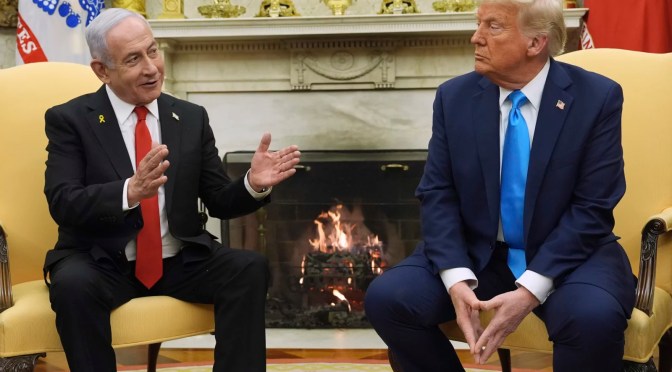
Following President Trump’s recent turn against Israel, the Israeli government has been scrambling to repair its relationship with its most important ally, the United States. To that end, Israel refrained from publicly criticizing the Memorandum of Understanding (MOU) with Iran, even though it views the agreement as a serious strategic threat. Prime Minister Netanyahu also ignored Trump’s reported vulgar personal attacks, calling him “fucking crazy,” among other things. Under U.S. pressure, Israel accepted fictitious ceasefires in Lebanon that resulted in the unnecessary deaths of IDF soldiers.
The Israeli government appears to believe that accommodating Trump will restore the relationship. It is far more likely that the opposite is true. Trump’s conduct toward Israel is not driven primarily by ideological differences or lack of personal loyalty. It is driven by power. He admires leaders who project strength, achieve decisive results, and refuse to bend under pressure. He loses respect for those whom he perceives as hesitant, indecisive, or overly accommodating.
Trump Rewards Strength
This pattern has been visible throughout Trump’s presidency. During his 2024 campaign, Trump argued that Israel was too small and publicly asked whether there was “any way of getting more” territory. After returning to office, he initially supported Israeli annexation of Judea and Samaria, the destruction of Hezbollah and proposed the emigration of Gaza’s population.
None of these objectives were realized. Instead, Israel repeatedly entered and withdrew from Gaza, Lebanon, Judea and Samaria without pursuing decisive victory or permanent annexation. Whether one agrees with those decisions or not, they likely reinforced Trump’s perception that Israel was unwilling or unable to finish the job.
The Contrast: Syria
Trump’s treatment of Syria’s Ahmed al-Shaara illustrates the opposite dynamic. Al-Shaara, formerly known as Mohammad al-Julani, founded Jabhat al-Nusra, originally an affiliate of al-Qaeda. The organization committed atrocities against Christians, Alawites, Shiites, and Druze. Even after taking power in Syria, massacres of minority communities continued under his rule, suggesting that his change in appearance, from military fatigues to a business suit, did not represent a change in character.
Yet Trump praised him as “a young, attractive guy. Tough guy. Very strong past. Fighter.”
Trump has even suggested that Israel allow Syria to deal with Hezbollah, saying, “I think they’d do a better job.” According to Fox News correspondent Trey Yingst, Trump has privately expressed frustration that Israel has been unable to “put Hezbollah away.” The point is not that Trump approves of al-Shaara’s past. Rather, he appears to respect what he sees as decisiveness and effectiveness.
Iran
The same pattern appeared during the conflict with Iran. At the outset, Trump described Iran’s leadership as “lunatics” and “crazy bastards.” Yet after Iran refused to capitulate and continued to resist American pressure, Trump’s rhetoric shifted noticeably. Speaking on Meet the Press, he remarked, “They’re strong. They’re proud.” Whether one agrees with Trump’s subsequent MOU or not, the sequence is notable. His language toward Iran became more respectful after it demonstrated determination rather than submission.
Erdoğan and Other Strongmen
Turkey’s President Recep Tayyip Erdoğan provides another example. Erdoğan has steadily centralized power, imprisoned political opponents, suppressed Kurdish movements, denied the Armenian genocide, maintained Turkey’s occupation of northern Cyprus, threatened Greece and Israel, and purchased Russian S-400 missile systems despite direct American objections, leading to Turkey’s removal from the F-35 program. Rather than distancing himself from Erdoğan, Trump has repeatedly praised him as “a great leader,” “a very strong leader,” and “a very strong man.”
Trump has shown similar admiration for other leaders who have resisted American pressure, including Vladimir Putin, Xi Jinping, and Kim Jong Un. The common denominator is not ideology. It is strength.
The Lesson for Israel
Trump frequently proposes ambitious ideas—annexing Greenland, acquiring the Panama Canal, making Canada the fifty-first state, relocating Gaza’s population, or placing Gaza under American control. Just as frequently, he abandons those ideas when confronted with determined opposition.
Israel has drawn the opposite lesson. Rather than demonstrating resolve, it has repeatedly deferred to American pressure in the hope of preserving Washington’s goodwill. That strategy fundamentally misunderstands how Trump, and the world generally, evaluates allies. Had Israel annexed southern Lebanon to the Litani River instead of repeatedly withdrawing, Trump would never have proposed placing the area under Syrian control or incorporating it into arrangements with Iran. Trump seeks solutions, not never-ending wars; decision, not hesitation.
A Broader Observation
For centuries, the Jewish people have viewed the world primarily through the lens of morality, assuming that other nations make decisions on the same basis. History suggests otherwise.
Nations may be influenced by moral considerations, but more often they are driven by power and economic interests. Israel has often failed to recognize that reality and finds itself disappointed when moral arguments alone fail to persuade. If Israel wishes to preserve its strategic position, not only with Trump but in the broader international system, it must understand that power commands respect in ways that accommodation often does not. Whether that reality is admirable is beside the point. It is, the way the world works, and has always worked.

